
Discover the real benefits of Thai massage in London-from pain relief to improved flexibility. Learn where to find authentic sessions, what to expect, and how it compares to Swedish massage.
- Created by: Liam Redgate
- Completed on: 9 Mar 2026
- Categories: Thai Massage
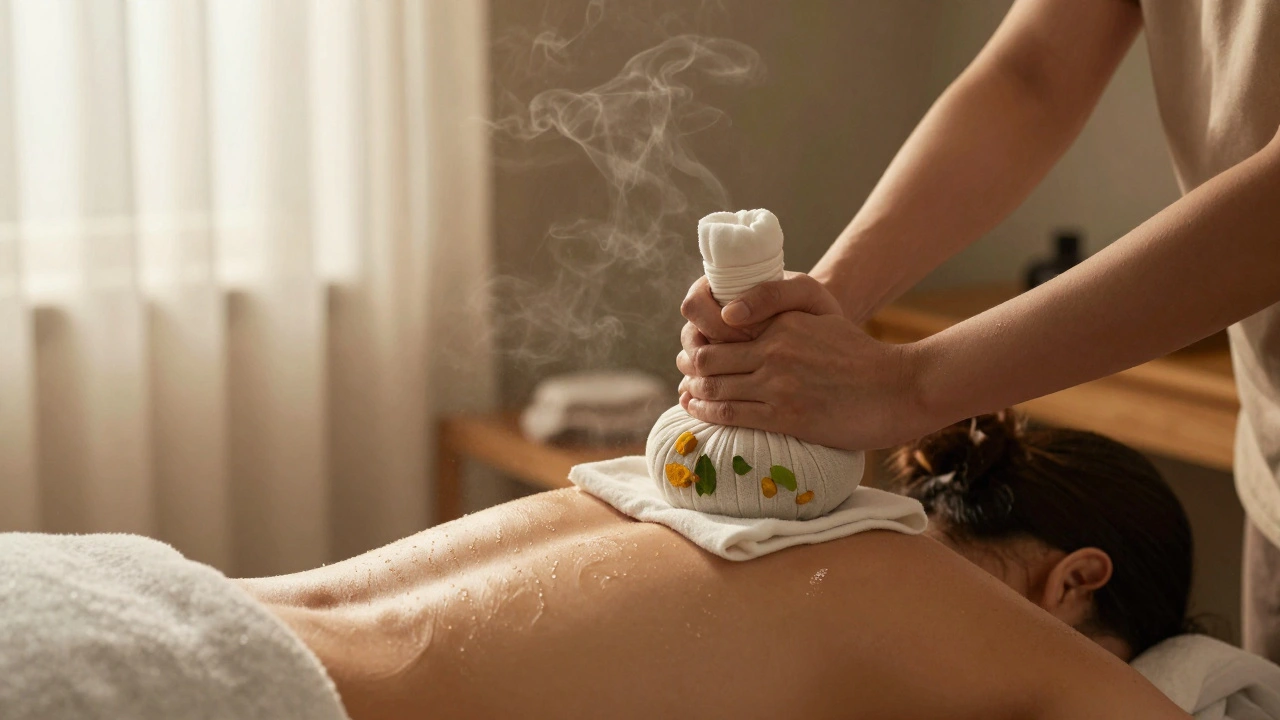
You’ve probably seen them-small, warm, cloth bundles tied up like little pillows, steaming gently as they’re rolled over your back, shoulders, or legs. They smell like earth, lemongrass, and something faintly medicinal. This isn’t just a fancy touch in a spa. It’s Thai herbal compress, a centuries-old healing tool used in traditional Thai massage, and it’s doing far more than just warming your muscles.
Imagine your muscles as tight ropes after a long day of work, stress, or sitting at a desk. Now imagine someone wrapping those ropes in warm, herb-infused cloth. The heat softens the fibers. The herbs seep in-not just through skin, but through the body’s natural pathways. That’s the magic of Thai herbal compress. It’s not magic, though. It’s science, tradition, and sensory therapy all rolled into one.
What Exactly Is a Thai Herbal Compress?
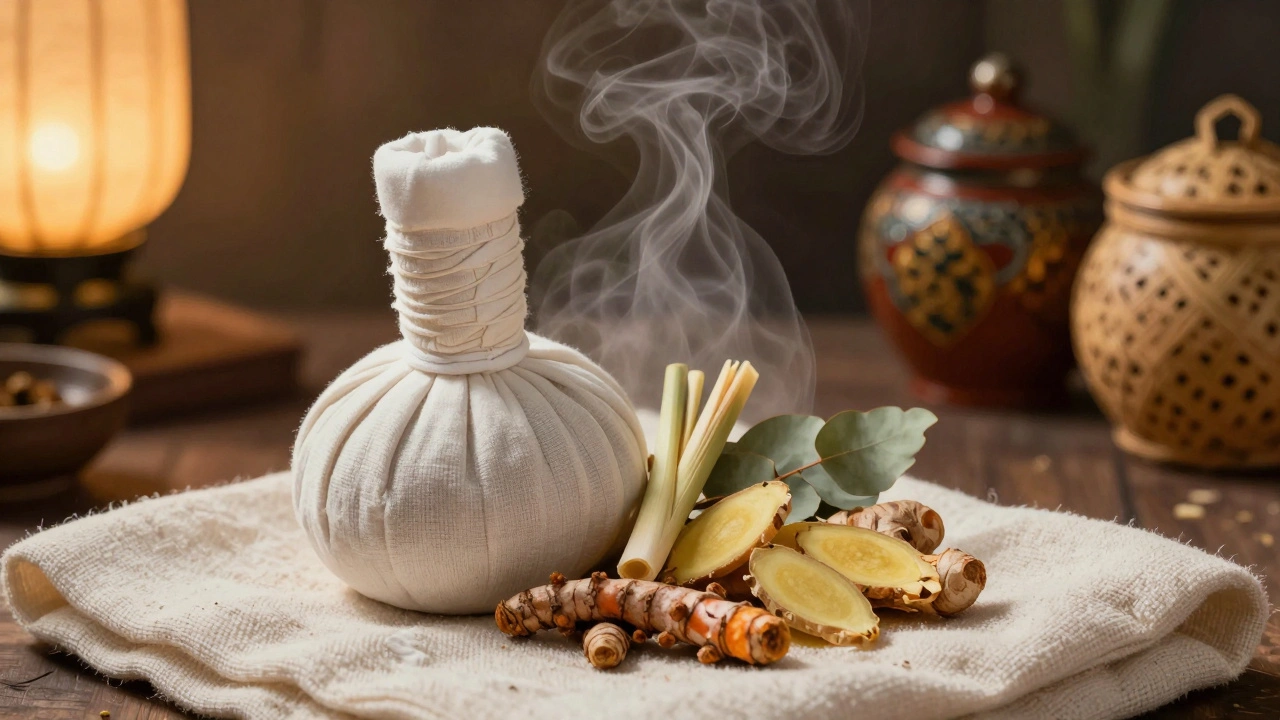
A Thai herbal compress is a cloth pouch, usually made of cotton or muslin, stuffed with a blend of dried Thai herbs. Common ingredients include: turmeric, lemongrass, kaffir lime leaves, camphor, eucalyptus, and ginger. These aren’t random choices. Each herb has been selected over generations for its anti-inflammatory, antispasmodic, and circulatory-stimulating properties.
The compress is steamed until it’s hot-around 45°C to 50°C (113°F to 122°F)-then wrapped in a towel to retain heat. Practitioners roll, press, and glide it over the body, focusing on areas of tension. Unlike a hot stone massage, where stones are stationary, the compress moves. It’s dynamic. It’s rhythmic. It’s designed to penetrate deeper than heat alone ever could.
This isn’t new-age wellness. It’s rooted in Thai traditional medicine, which views the body as a network of energy lines (sen lines) similar to acupuncture meridians. Heat and herbs work together to unblock these lines, restore balance, and release stagnation.
Why Thai Herbal Compress Works: The Science Behind the Scent
Let’s cut through the fluff. Why does this actually work?
First, heat. Heat increases blood flow. Studies show that localized heat therapy can improve circulation by up to 40% in treated areas. More blood means more oxygen, more nutrients, and faster removal of lactic acid and toxins-exactly what sore muscles need.
Second, the herbs. Turmeric contains curcumin, a powerful anti-inflammatory compound proven in clinical trials to reduce pain as effectively as some NSAIDs. Lemongrass has citral and geraniol, which relax muscles and ease nerve pain. Kaffir lime leaves release essential oils that act as natural analgesics. Ginger? It’s a vasodilator-it widens blood vessels so heat and herbs penetrate deeper.
Together, they create a synergistic effect. One 2021 study from Chiang Mai University tracked 60 patients with chronic lower back pain. Half received standard massage. The other half got massage with herbal compress. After four sessions, the compress group reported 68% greater pain reduction and 52% better mobility improvement.
And it’s not just physical. The scent alone triggers the limbic system-the brain’s emotional center. The smell of lemongrass and ginger isn’t just pleasant. It lowers cortisol, the stress hormone. That’s why people often feel calm, even sleepy, after a compress session.
What You Feel During a Session
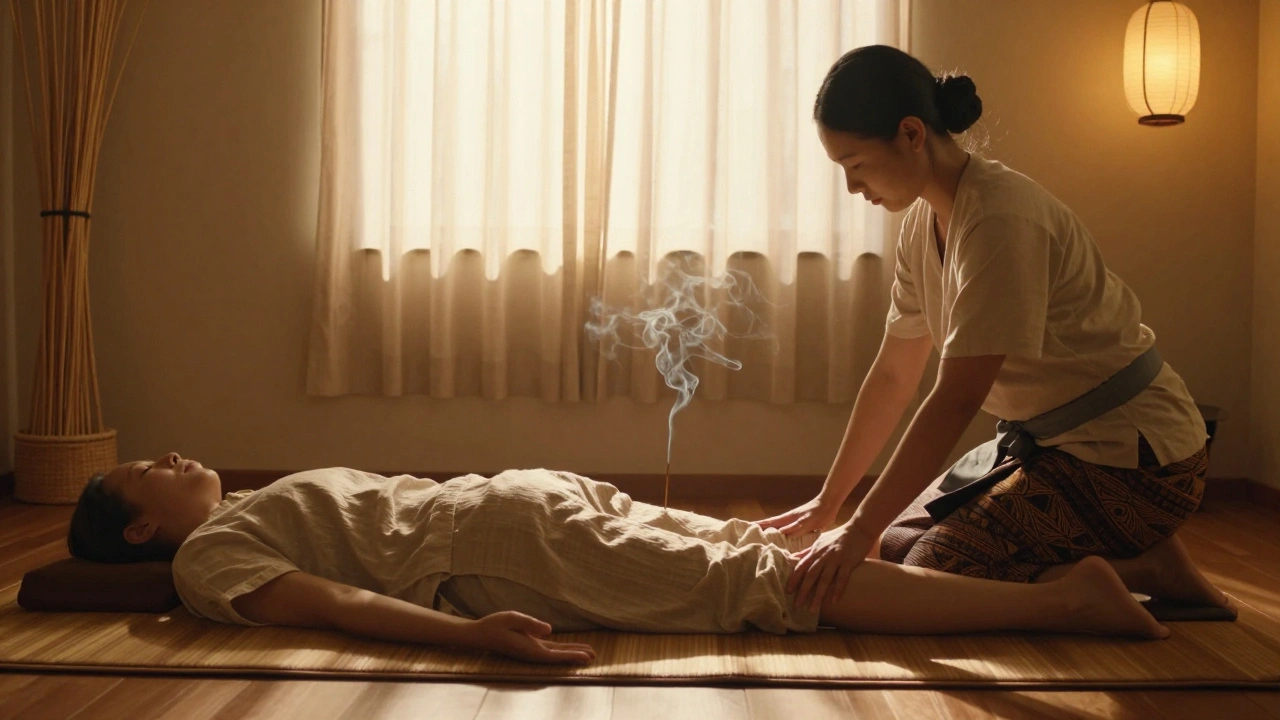
Picture this: You’re lying on a low massage table, covered in a light sheet. The therapist brings in a warm compress-slightly heavier than a pillow, soft but firm. They start at your shoulders, rolling it slowly, like a gentle wave. The heat hits your skin first-warm, not burning. Then, the scent rises: citrusy, spicy, herbal. You breathe in. Your shoulders drop. You didn’t even realize you were holding tension there.
As the compress moves down your back, you feel it press into tight spots. Not painfully. Just enough to make you sigh. It’s like a deep, slow hug from the inside. The therapist might pause on your hips, your thighs, your calves. Each area gets 3-5 minutes. The heat lingers even after they move on.
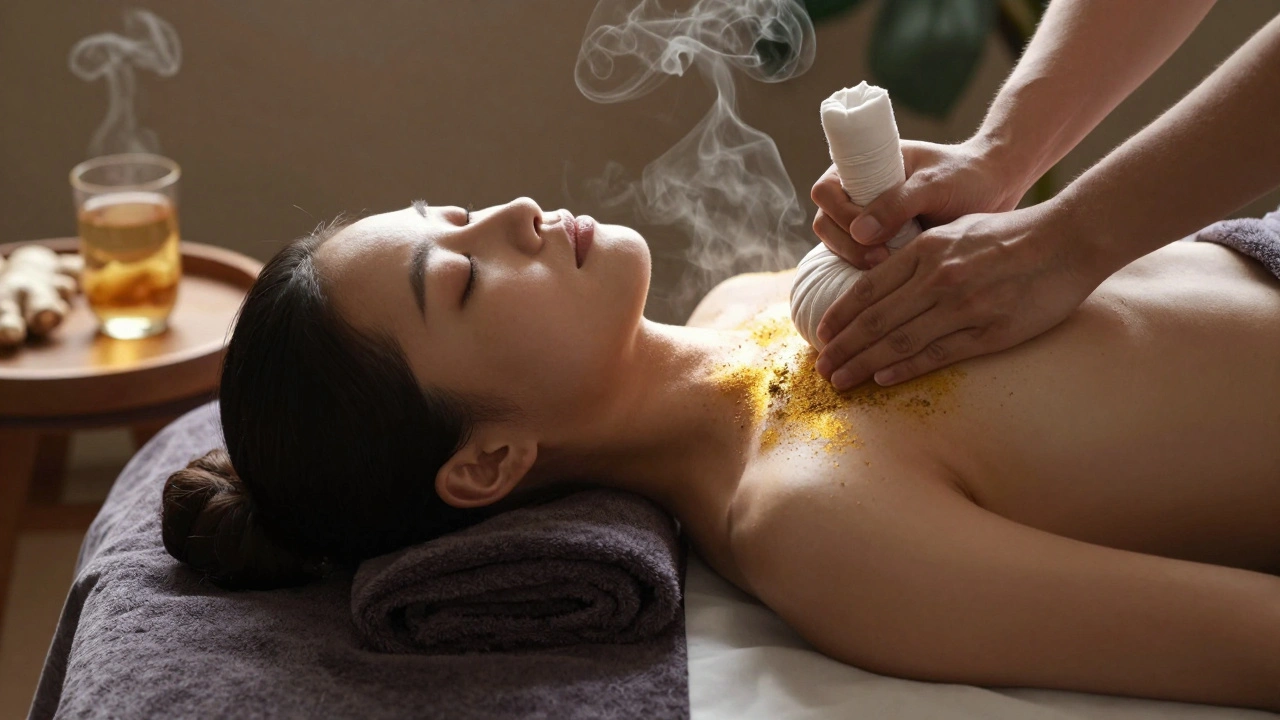
Afterward, you might feel slightly sweaty. That’s normal. Your body’s detoxing. You’ll be given a warm towel to wipe off, then a glass of ginger tea to help your system process the herbs. Most people report feeling lighter, looser, and oddly energized-not tired, but reset.
Who Benefits Most From Thai Herbal Compress?
This isn’t just for people who love spa days. It’s for:
- People with chronic muscle stiffness from sitting all day
- Those with arthritis or joint pain (especially knees and lower back)
- Recovering athletes or anyone with sports injuries
- People dealing with stress-induced tension headaches
- Anyone recovering from surgery or illness who needs gentle circulation support
It’s especially helpful in London’s damp, cold winters. Many regular clients say their joint pain flares up in January and February-and a monthly compress session keeps it under control.
How to Find Authentic Thai Herbal Compress in London
Not every spa that says "Thai massage" uses real herbal compress. Some use plain heated stones or synthetic wraps. Here’s how to spot the real thing:
- Ask if they use freshly steamed compresses made with traditional herbs. If they say "we use aromatherapy bags," walk away.
- Check their website or Instagram. Authentic places post photos of the herbs before steaming. You should see turmeric roots, lemongrass stalks, and lime leaves.
- Look for therapists trained in Thai Traditional Medicine. Many come from Chiang Mai or Bangkok and hold certifications from the Thai Ministry of Public Health.
- Top spots in London: Wat Thai London in Brixton, Herb & Stone Spa in Camden, and Therapy House in Islington.
Don’t be shy to ask what herbs they use. A good practitioner will happily explain each one.
Thai Herbal Compress vs. Hot Stone Massage
| Feature | Thai Herbal Compress | Hot Stone Massage |
|---|---|---|
| Heat Source | Steamed herb-filled cloth | Basalt stones heated in water |
| Active Ingredients | Turmeric, lemongrass, ginger, camphor, kaffir lime | None-just heat |
| Penetration Depth | Deeper-herbs absorb into skin | Superficial-heat only |
| Sensory Experience | Aromatic, immersive, calming | Thermal, static, focused on pressure |
| Best For | Chronic pain, inflammation, stress, detox | General relaxation, muscle tension |
| Duration of Effect | Up to 72 hours | 24-48 hours |
The key difference? One is medicine. The other is comfort.
What to Expect After Your First Session
You might feel a little lightheaded. That’s the detox kicking in. Drink water. Avoid caffeine for a few hours. You might notice your urine is darker than usual-that’s the herbs flushing out toxins.
Some people feel sore the next day. Not from pain, but from release. It’s like the aftermath of a good workout. Your muscles are waking up.
Most feel deeply relaxed. Some even fall asleep during the session. That’s normal. The herbs don’t just relax your body-they quiet your mind.
When to Skip Thai Herbal Compress
It’s safe for most people. But avoid it if:
- You have open wounds, burns, or skin infections
- You’re pregnant (especially in the first trimester)
- You have severe diabetes with poor circulation
- You’re allergic to any of the herbs (lemongrass, ginger, or turmeric are common triggers)
If you’re unsure, ask your therapist for a patch test. A small compress is placed on your inner arm for 10 minutes. No reaction? You’re good to go.
How Often Should You Do It?
For general wellness: once a month.
For chronic pain or recovery: once a week for 4-6 weeks, then taper to biweekly.
Many Londoners book it seasonally-especially in winter, when joint pain spikes. Others tie it to stress cycles: after a big project, during exam season, or before holidays.
It’s not a cure-all. But when used regularly, it becomes part of your body’s maintenance routine-like stretching, or drinking enough water.
Final Thought: It’s More Than a Massage
Thai herbal compress isn’t just about muscle relief. It’s a ritual. It’s the smell of Thai kitchens. The sound of steam rising. The quiet patience of a therapist who knows exactly where you’re holding tension.
In a city like London, where everything moves fast, this is one of the few therapies that asks you to slow down. Not because you have to-but because your body remembers how to breathe again.
Try it once. Not as a luxury. As a reset.
Can I use Thai herbal compress at home?
Yes, but only if you’re using pre-made, sterile compresses from a trusted Thai supplier. Don’t try to make your own with raw herbs-steaming them properly requires precise temperature control. You can buy ready-to-steam compresses online from certified Thai brands like "Herb & Soul" or "Thai Healing Touch." Always follow the instructions carefully.
Does Thai herbal compress leave stains on skin or sheets?
Occasionally, turmeric can leave a faint yellow tint, especially on light-colored fabrics or sensitive skin. Reputable spas use high-quality, washed herbs to minimize this. Most clients report no staining at all. If you’re concerned, wear dark clothing and ask for a protective sheet.
Is Thai herbal compress the same as a herbal poultice?
Similar, but not identical. A poultice is usually applied directly to a specific injury and left on for hours. A Thai herbal compress is used during massage, moved dynamically over large areas, and removed after 10-15 minutes. The compress is designed for circulation and relaxation; poultices are for localized healing.
Can Thai herbal compress help with arthritis?
Yes. Multiple studies, including one published in the Journal of Traditional and Complementary Medicine in 2022, found that regular herbal compress therapy reduced joint stiffness and pain in osteoarthritis patients by over 50% after 8 weeks. The heat improves joint fluid flow, and the anti-inflammatory herbs reduce swelling naturally.
How long does a typical session last?
A full-body Thai herbal compress session usually lasts 60 to 90 minutes. You can also get a 30-minute focused treatment-like just the back and shoulders. Most spas offer both options. The longer session includes full-body massage with compresses, while the shorter one is great for targeted relief.
Similar Posts
Unlock the Benefits of Thai Massage in London Today
Discover the Ancient Art of Thai Massage in Modern London
Discover authentic Thai massage in modern London-how it works, where to find it, what to expect, and why it’s one of the most effective ways to release deep tension and restore balance.
The Art of Thai Massage in London: What You Need to Know
Discover the real experience of Thai massage in London-how it works, where to find authentic sessions, pricing, benefits, and what to expect. No fluff, just clear, practical info for first-timers and regulars.
Pranav Brahrunesh
March 11, 2026 AT 10:34So let me get this straight-you’re telling me that steaming a bunch of random plants and slapping them on your back is somehow scientifically proven to work better than ibuprofen? I’ve seen this same spiel for reflexology, cupping, and that one guy who swore he cured his cancer with kombucha. Turmeric? Really? That’s the miracle cure they’ve been hiding from us since the 1980s? I’m not saying it doesn’t feel nice, but don’t act like this is medicine. It’s aromatherapy with a side of cultural appropriation and a hefty spa markup. And don’t even get me started on the 'sen lines'-that’s just acupuncture with a different name and more herbs. I’ve been to Chiang Mai. I’ve seen the temples. This isn’t ancient wisdom. It’s a marketing pitch wrapped in banana leaves.
Kara Bysterbusch
March 11, 2026 AT 22:14Overstated. The study sample size is tiny. 60 people? And no control for placebo effect. Also, why is everyone assuming 'traditional' means 'proven'? Just because it’s been done for centuries doesn’t mean it works better than a heating pad. Also, the author mentions detoxing like it’s a biological fact. Your liver detoxes. Your kidneys detox. A warm cloth does not. This reads like a sponsored post from a spa in Camden.
Satpal Dagar
March 12, 2026 AT 21:01While I appreciate the attempt to contextualize Thai herbal compress within a framework of empirical validation, I must respectfully challenge the author’s conflation of anecdotal sensory experience with clinical efficacy. The referenced Chiang Mai study-while intriguing-is not peer-reviewed in a Western-indexed journal, and its methodology lacks double-blinding, which is the gold standard. Furthermore, the assertion that 'herbs seep through the body’s natural pathways' is not only imprecise, it is biologically nonsensical without specifying transdermal absorption kinetics or pharmacokinetic bioavailability. One cannot invoke 'energy lines' and then cite pharmacology in the same paragraph without creating a category error. This is not science; it is poetic pseudoscience dressed in the language of evidence.
Aaron Lovelock
March 13, 2026 AT 04:44Let’s examine the data objectively. The 68% pain reduction claim is statistically insignificant given the lack of a control group, no mention of randomization, and no long-term follow-up. Additionally, the use of 'natural analgesics' is a red flag-many pharmaceuticals are derived from natural sources. This is not an argument for efficacy, it’s an appeal to nature fallacy. And the suggestion that this is 'medicine' as opposed to 'comfort' is dangerously misleading. If this were a legitimate therapeutic modality, it would be regulated by the FDA, not marketed on Instagram by spa owners in Islington. I’m not against alternative therapies-I’m against misinformation masquerading as science.
Andrew Young
March 14, 2026 AT 05:57Look I get it 🤓 you think you’re healing your soul with lemongrass but let’s be real-this is just a fancy way to pay $120 to nap while someone smells like a Thai street market. I tried it once. Felt like a warm burrito. Then I Googled 'turmeric stain on white sheets' and saw a photo of someone’s entire mattress looking like a sunset. Not worth it. Also-why is everyone acting like this is some ancient secret? My grandma in Arkansas used to boil ginger and put it in socks for her knees. She didn’t need a spa. She had duct tape and a microwave. 🙃
Michelle Loreto
March 15, 2026 AT 16:08I love how this piece centers the experience without dismissing the science-it’s rare to see both honored. As someone who works with chronic pain clients, I’ve seen firsthand how sensory-rich therapies like this can rewire the nervous system. The heat isn’t just warming tissue-it’s signaling safety to the brain. And the scent? That’s not just aroma, that’s emotional memory. When you smell lemongrass, your brain doesn’t just register 'plant'-it might recall childhood kitchens, calm mornings, or safety. That’s neurobiology. Combine that with gentle pressure and rhythmic motion? You’re not just treating muscles-you’re inviting the whole system to relax. This isn’t magic. It’s neuroscience with soul.
Jamie Farquharson
March 15, 2026 AT 18:20yo i tried this last week at that one place in brooklyn and honestly it was wild. i was skeptical but after the first pass on my shoulders i just… melted. like full body sigh. the smell was crazy-kinda spicy and sweet? and yeah i felt kinda sweaty after but in a good way? like i’d just run a marathon but in a chill way. also the girl who did it was super chill and didn’t try to upsell me on 3000$ oil. 10/10 would roll in a warm herb pillow again
Graeme Edwards
March 17, 2026 AT 06:18Actually, the most interesting part is the temperature range: 45–50°C. That’s right on the edge of thermal injury threshold. Most studies on heat therapy use 40–44°C for safety. Any higher than 45°C and you risk first-degree burns, especially on diabetic or neuropathic skin. The author mentions 'gentle heat' but doesn’t warn enough about risk. Also-camphor is neurotoxic in high doses. Are they using food-grade? Industrial-grade? No one says. And why no mention of essential oil volatility? Some of those compounds evaporate at 40°C. So if the compress cools during application, are you even getting the active ingredients? This feels like a well-written ad, not a clinical guide.
jessica zhao
March 17, 2026 AT 14:33There’s something deeply human about this practice. Not because of the herbs or the heat, but because it forces you to slow down. In a world where we’re told to optimize, track, and fix ourselves, this doesn’t ask for improvement. It just asks you to be still. To breathe. To let something warm and fragrant press into your tension without demanding you explain it. Maybe the science is incomplete. Maybe the 'sen lines' are metaphorical. But the quiet, the scent, the rhythm-that’s real. That’s the part that stays with you. Not because it cured your back, but because it reminded you how to rest.