
If you're constantly tense, tired, or stiff, your body might be begging for a massage. Discover the 10 clear signs you need to see a massage therapist in London-and why waiting could make things worse.
- Created by: Liam Redgate
- Completed on: 8 Mar 2026
- Categories: Massage Therapy
You’ve had one of those weeks. The kind where your alarm goes off too early, your back aches from hunching over a screen, and by 7 p.m., you’re just staring at the wall, too tired to even think about cooking dinner. You know you need to reset, but you’re not sure where to start. What if the answer isn’t another cup of coffee or a long walk-it’s a massage therapy session in London?
Massage therapy isn’t just about relaxation. It’s a reset button for your nervous system, your muscles, and your mind. And in London, you’ve got access to some of the most skilled practitioners in the UK-people who don’t just rub your back, but help you reconnect with yourself.
What Exactly Is Massage Therapy?
Massage therapy is more than a pampering treat. It’s a science-backed practice that uses touch to influence your body’s physical and emotional state. Unlike a spa massage, which often focuses on relaxation alone, massage therapy targets specific issues: tight shoulders from commuting, headaches from screen fatigue, or even sleep problems tied to stress.
Therapists in London are trained in anatomy, physiology, and pathology. They don’t just guess what’s wrong-they assess. They’ll ask about your sleep, your job, your stress levels, even your breathing patterns. A good session starts with a conversation, not just hands on skin.
Think of it like tuning a car. You don’t just change the oil-you check the belts, the fluids, the alignment. Massage therapy does the same for your body.
Why Londoners Are Turning to Massage Therapy
London moves fast. The Tube’s crowded, the meetings are back-to-back, and the city never really sleeps. But that constant buzz takes a toll. A 2025 survey of London wellness clients found that 68% of people who started regular massage therapy reported better sleep within two weeks. Another 61% said their anxiety levels dropped noticeably.
It’s not magic. It’s biology. Massage lowers cortisol (the stress hormone) by up to 30% in just one session, according to research from the University of Miami’s Touch Research Institute. At the same time, it boosts serotonin and dopamine-your brain’s natural feel-good chemicals.
People in Shoreditch use it to recover from long shifts at tech startups. Nurses in Southwark use it to manage chronic back pain. Students in Camden use it to ease exam stress. It’s not a luxury-it’s a tool.
Types of Massage Therapy Available in London
Not all massage therapy is the same. Here’s what you’ll find across London’s clinics and studios:
- Swedish Massage - Gentle, flowing strokes. Perfect if you’re new to therapy or just need to unwind after a long week.
- Deep Tissue Massage - Targets deeper muscle layers. Ideal for chronic tension, sports injuries, or if you’ve been sitting at a desk for years.
- Myofascial Release - Focuses on the connective tissue around muscles. Great for people with stiffness that doesn’t go away with stretching.
- Trigger Point Therapy - Pinpoints knots (trigger points) that cause pain elsewhere. Like when your shoulder pain is actually caused by a tight muscle in your neck.
- Thai Massage - A mix of yoga-like stretches and acupressure. Done on a mat, fully clothed. Popular in areas like Brixton and Peckham.
- Neurological Massage - A newer approach that works with the nervous system directly. Used for anxiety, insomnia, and PTSD. Found mostly in private clinics in Kensington and Hampstead.
Most therapists offer a blend of techniques. You don’t have to pick one-just tell them what you’re feeling, and they’ll tailor it.
How to Find the Right Massage Therapist in London
Not every massage therapist is the same. Here’s how to find one who actually helps:
- Check qualifications - Look for someone registered with the Complementary and Natural Healthcare Council (CNHC). That means they’ve met national standards.
- Read reviews with context - Don’t just look for 5-star ratings. Look for comments like, “She noticed I was holding tension in my jaw” or “He asked about my sleep habits.” That’s a sign they’re listening.
- Try a consultation - Many clinics offer a free 10-minute chat before your first session. Use it. Ask how they’d handle your specific issue.
- Location matters - If you’re in Zone 2, you don’t need to travel to Zone 1. There are excellent therapists in Croydon, Walthamstow, and even Isleworth.
- Trust your gut - If something feels off during the session, speak up. A good therapist welcomes feedback.
Platforms like TherapyMate and London Massage Collective let you filter by specialty, gender preference, and even whether they offer evening or weekend slots.

What to Expect During Your First Session
First-timers often worry about what happens. Here’s the real deal:
- You’ll fill out a short health form. No judgment-just facts.
- You’ll chat for 5-10 minutes. They’ll ask where you hurt, how you sleep, what stresses you out.
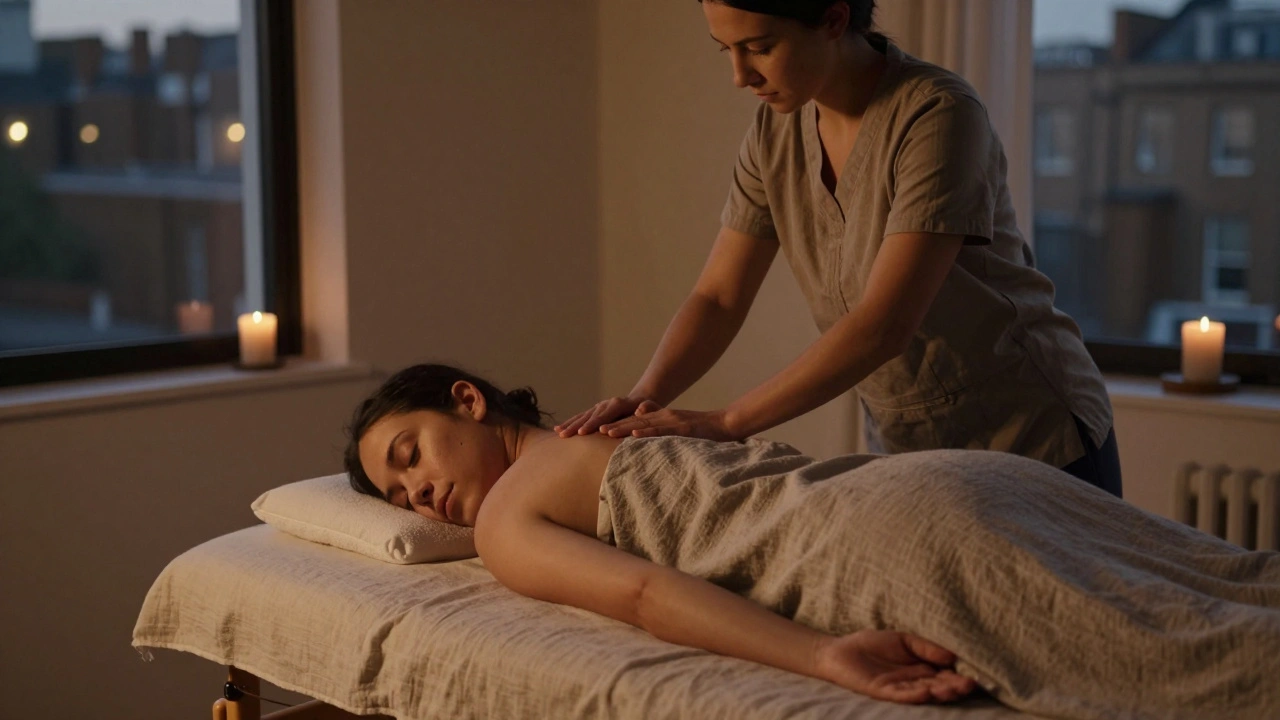
- You’ll undress to your comfort level. You’re covered with towels the whole time. Only the area being worked on is exposed.
- The pressure starts light. They’ll check in: “Is this okay?” If it’s too much, say so. No shame.
- You might feel a little sore the next day-especially if it’s your first deep tissue session. That’s normal.
- You’ll leave feeling calm, but not sleepy. More like… centered.
Most sessions last 60 or 90 minutes. Don’t rush. Your body needs time to unwind.
Pricing in London: What You’ll Pay
Prices vary based on location, experience, and session length:
- 60-minute session - £55 to £85
- 90-minute session - £75 to £110
- Therapist with specialisation (e.g., sports, neurological) - £90 to £130
- Package deals (5 sessions) - Often 10-15% off
Some clinics offer sliding scales for students or low-income clients. Don’t assume you can’t afford it-ask. Many therapists in Hackney, Barking, and Lewisham run community-focused practices.
Insurance? A few private health plans in the UK now cover massage therapy if prescribed by a GP for chronic pain. Worth checking.
What to Avoid
Not every massage is therapy. Here’s what to watch out for:
- Too cheap - If a session is £30 with no qualifications listed, it’s likely not a trained therapist.
- No consultation - If they start rubbing your back without asking about your health, walk out.
- Pressure to book more - A good therapist won’t push you into a package. They’ll let you feel the difference first.
- Overly sexualized environment - Therapy is clinical, not sensual. If it feels more like a spa fantasy, it’s not therapy.
Massage therapy is about healing, not fantasy.

Massage Therapy vs. Spa Massage in London
| Feature | Massage Therapy | Spa Massage |
|---|---|---|
| Primary Goal | Healing, pain relief, functional improvement | Relaxation, indulgence, luxury experience |
| Practitioner Training | Certified, often CNHC-registered, anatomy background | Basic training, may not have medical knowledge |
| Session Structure | Assessment → Treatment → Follow-up plan | Quick setup → Massage → Out the door |
| Focus Area | Specific problem areas (e.g., lower back, neck tension) | General full-body relaxation |
| After Effects | Improved mobility, reduced pain, better sleep | Temporary calm, may feel groggy |
| Typical Price (60 min) | £55-£130 | £70-£150 |
The difference? One fixes your body. The other gives you a break. Both have value-but if you’re looking to rediscover yourself, therapy is the path.
Frequently Asked Questions
Can massage therapy help with chronic pain in London?
Yes. Many Londoners with lower back pain, arthritis, or repetitive strain injuries find lasting relief through regular massage therapy. A 2024 study in the British Journal of Sports Medicine showed that participants with chronic lower back pain reduced their pain medication use by 40% after 8 weekly sessions of deep tissue and myofascial therapy. It doesn’t cure the condition, but it gives your body the space to heal.
Is massage therapy safe during pregnancy in London?
Absolutely-but only with a therapist trained in prenatal massage. These therapists know which pressure points to avoid and how to position you safely. Many clinics in areas like Richmond, Wimbledon, and Islington specialize in pregnancy care. Always mention your pregnancy when booking.
How often should I get massage therapy?
It depends on your needs. For acute pain or stress, once a week for 4-6 weeks helps reset your system. For maintenance, once every 3-4 weeks keeps tension from building. Some people do monthly-like a tune-up for your body. Think of it like brushing your teeth: small, regular care prevents bigger problems.
Do I need to undress completely?
No. You undress to your comfort level. Most people keep their underwear on. Therapists use draping techniques to ensure only the area being worked on is exposed. You’re always covered. If you’re uncomfortable, speak up. Your privacy is non-negotiable.
Can massage therapy help with anxiety or depression?
It can be a powerful support tool. While it’s not a replacement for therapy or medication, massage lowers cortisol, increases serotonin, and helps break the cycle of stress-induced tension. Many clients in London report feeling more grounded, less overwhelmed, and better able to cope after consistent sessions. It’s not magic-but it’s real.
Ready to Rediscover Yourself?
You don’t need to wait until you’re broken to try massage therapy. You don’t need to spend a fortune. You just need to make one appointment.
Start small. Book a 60-minute Swedish or deep tissue session. Let someone who knows what they’re doing help you release what you’ve been holding onto. Not because you’re weak. But because you’re human.
London is loud. But beneath the noise, your body is still whispering. Listen to it.
Similar Posts


10 Signs You Need to Book an Appointment with a Massage Therapist
Massage Therapy in London: A Holistic Approach to Health
Discover how holistic massage therapy in London is helping residents manage stress, recover from pain, and improve sleep. Learn the best types, where to find qualified therapists, pricing, and what to expect during a session.
Massage London: Top-Rated Therapies for Stress Relief
This article gives you the scoop on the best massage therapies across London, helping you discover what works for your needs and budget. Get practical tips on how to choose the right massage, what to expect during a session, and how much you’ll pay. We’ll break down different styles of massages available around the city, highlight what makes each popular, and point out how to find trustworthy therapists. If you're after real, hands-on advice to soothe your stress in London, this is your guide.
Sriram T
March 9, 2026 AT 19:46OMG this post is literally a vibe 🙌 I’ve been doing massage therapy in Shoreditch for 6 months now and it’s changed my life like bro… I used to be this zombie scrolling at 2am, now I’m like ‘hey I slept 7 hours and I didn’t dream about my boss yelling’ 😭
Also the therapist I go to? She’s got a tattoo of a spine on her forearm. That’s commitment. That’s not just a job, that’s a lifestyle. I cried the first time she worked on my thoracic outlet. Not because it hurt-because I finally felt MYSELF again. 🥹
Also if you’re scared of deep tissue? Just tell ‘em ‘go easy’ and they’ll treat you like a fragile orchid. I’m 6’2” and 220lbs and I still say ‘please be gentle’ like a drama queen. No shame.
Jonny BiGSLiCE
March 10, 2026 AT 05:06There’s a profound biological truth here that’s often obscured by wellness marketing. Massage therapy doesn’t merely relax muscles-it modulates the autonomic nervous system, shifting sympathetic dominance toward parasympathetic activation. This is not anecdotal; it’s neurophysiological.
The reduction in cortisol observed in studies is consistent with findings in psychoneuroimmunology, where tactile stimulation triggers vagal nerve activity, lowering inflammatory cytokines and enhancing immune function. The fact that Londoners report improved sleep and reduced anxiety isn’t coincidence-it’s a measurable physiological cascade.
What’s remarkable is how underutilized this modality remains in public health discourse. We subsidize pharmaceuticals, yet hesitate to fund somatic interventions with equal efficacy. The real luxury isn’t the price-it’s the access.
Kiana Rigney
March 11, 2026 AT 06:37Ugh. I hate how this post romanticizes massage therapy like it’s some mystical cure-all. Let’s be real-most of these therapists are overpriced estheticians with a 200-hour certification they got in Bali.
I went to one in Notting Hill last year. They didn’t even ask about my scoliosis. Just started massaging my neck like I was a mannequin. I left feeling like I’d been attacked by a very expensive octopus.
And don’t get me started on ‘neurological massage.’ That’s not a thing. It’s just Swedish with a fancy name and a $40 surcharge. If you’re treating PTSD with pressure points, you’re not a healer-you’re a con artist with essential oils.
Also, why are we all pretending this isn’t just another capitalist trap? ‘Book 5 sessions for 15% off!’ Like, wow, I didn’t realize my trauma came with a loyalty card.
Hannah Johnson
March 12, 2026 AT 07:31Hey, I just wanted to say THANK YOU for this post. I’m a nurse in Southwark and I’ve been doing 90-minute deep tissue every 3 weeks since last fall. My chronic shoulder pain? Gone. My sleep? Actually restful. I used to take ibuprofen like candy.
Also-YES to the consultation! I went to one place that skipped it and I was like… nope. Walked out. You should NEVER feel rushed or ignored.
And if you’re worried about cost? I found this amazing therapist in Walthamstow who does sliding scale. She’s got a sign in her window: ‘Pay what you can.’ I paid £30. She gave me a hug and a tea bag. That’s the real deal.
Also-Thai massage on a mat? LIFE CHANGER. I thought I was too stiff, but she stretched me like a pretzel and I laughed so hard I cried. Don’t be scared. Just try one session. You’ve got nothing to lose and your body to gain. 💪
Anna Krol
March 14, 2026 AT 03:20As someone who moved from Seoul to London last year, I had no idea massage therapy was this deep here. Back home, we have jjimjilbangs and traditional Korean bodywork, but this whole assessment-before-touch thing? Totally new.
I went to a therapist in Camden who asked me about my breathing patterns. I didn’t even know I was holding my breath all day. She had me lie there for 5 minutes just breathing slowly. I cried. Not because it hurt-but because no one had ever asked me that before.
Also, the myofascial release? I didn’t even know I had fascia. Now I know it’s like the body’s invisible network. It’s wild. I started reading up on connective tissue. Now I’m obsessed.
And yeah, the price seems high at first, but when you think about how much you spend on coffee, Uber, and bad takeout… this is the only thing that actually fixes something. Not just masks it.
London’s weird, loud, and exhausting-but there are quiet pockets of real care here. This post reminded me to find them.
Chaunt Elyza
March 15, 2026 AT 00:24STOP. I’ve been doing this for 8 years and I’m basically a massage therapist now. 🤓
Swedish? Useless. Deep tissue? Only if you’re a brick wall. Myofascial? Meh. But THERAPEUTIC TRIGGER POINT? That’s the REAL DEAL. 🔥
I go to this one woman in Hampstead-she has a spreadsheet of my trigger points. She knows when I’m stressed before I do. I’m not joking. She said last week: ‘You’re holding your left trapezius like you’re hugging a ghost.’ I almost passed out.
Also-NEUROLOGICAL MASSAGE IS A GAME CHANGER. I have anxiety and she literally rewired my nervous system. I don’t need Xanax anymore. I just need her thumbs. 💅
And if you think £130 is expensive? You’re paying £7 for a latte and crying about it. Wake up. This isn’t a luxury-it’s your body’s subscription to sanity.
Also-DON’T wear deodorant. It messes with the oils. I learned that the hard way. 😅