
Discover how a personalized full body massage can relieve stress, ease chronic tension, and restore balance to your body. Learn the types, benefits, what to expect, and how to find the right therapist for you.

- Created by: Liam Redgate
- Completed on: 13 Jan 2026
- Categories: Massage Therapy
You’ve got back pain. Or maybe it’s your neck, shoulders, or knees. You’ve tried stretching, ice packs, and that one YouTube video that promised relief in five minutes. Nothing stuck. Now you’re staring at two options: a massage therapist or a chiropractor. Which one actually helps? And more importantly-which one is right for you?
What’s the Real Difference?
At first glance, both massage therapists and chiropractors seem like pain fixers. You go in feeling tight, achy, or stiff, and you walk out feeling better. But the way they get you there? Totally different.
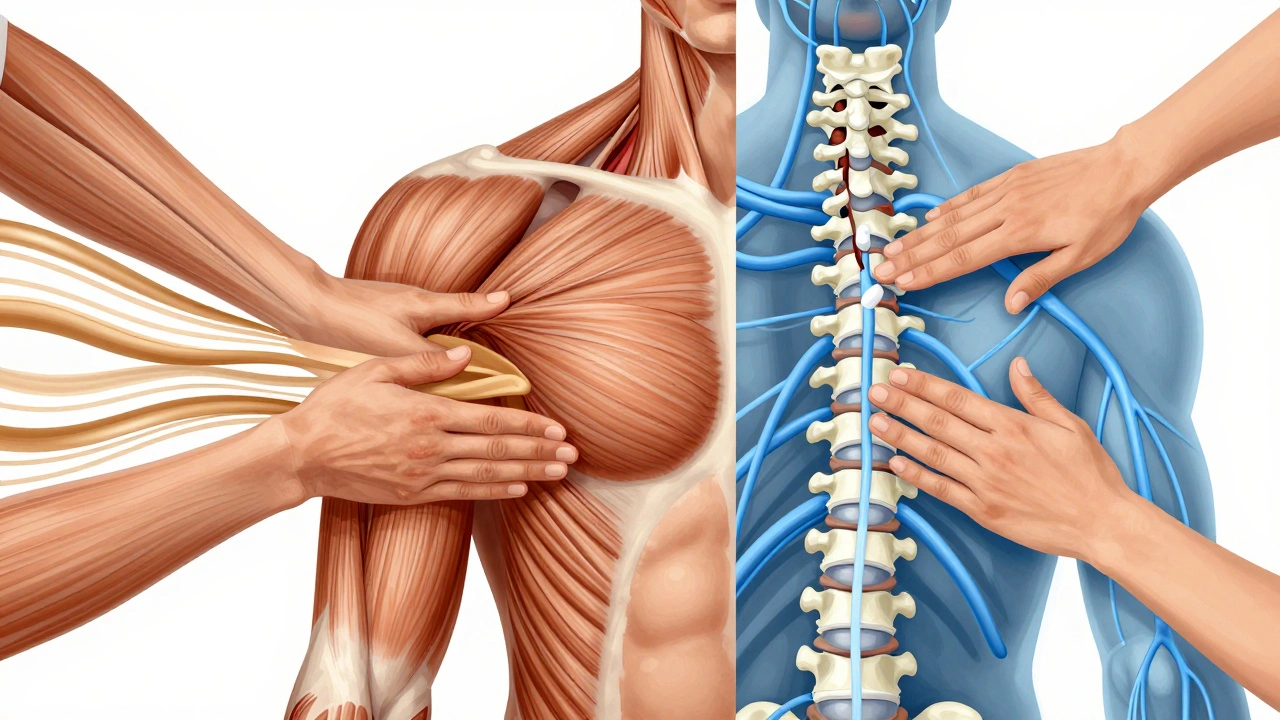
A massage therapist is a soft-tissue expert. Their tools? Hands, forearms, elbows. Their goal? To release tension in muscles, improve circulation, and calm your nervous system. Think of them as the body’s janitors-clearing out the stress buildup that’s been piling up in your shoulders after months of hunching over a desk.
A chiropractor is a joint and spine specialist. They use quick, precise adjustments-often with a pop-to realign vertebrae and restore movement. Their focus isn’t on the muscle itself, but on how the bones around it are positioned. If your spine is out of whack, a chiropractor tries to fix the structure so the muscles don’t keep tightening up in response.
So here’s the simple version: massage therapists work on the soft stuff-muscles, tendons, fascia. Chiropractors work on the hard stuff-bones, joints, nerves.
When Should You See a Massage Therapist?
You’re sitting at your desk, staring at a screen, and your upper traps feel like they’ve been knotted by a rugby player. Your shoulders are permanently raised. Your breath feels shallow. That’s not a spinal misalignment-that’s chronic stress and muscle fatigue.
That’s when a massage therapist helps.
Studies from the Journal of Clinical Psychiatry show that regular massage therapy reduces cortisol (the stress hormone) by up to 31% after just one session. People who get weekly massages report better sleep, less anxiety, and fewer tension headaches. If your pain feels like it’s coming from tightness, soreness, or general fatigue-not sharp, shooting, or nerve-related pain-you’re likely a good candidate for massage.
Think about it: if your car’s engine is overheating because the radiator’s clogged, you don’t start adjusting the chassis. You clean the radiator. Massage therapy is like cleaning out the clogs in your muscles.
Common reasons people in London book massage therapists:
- Chronic tension from long commutes or desk jobs
- Recovery after a workout or sports activity
- Stress-related headaches or jaw clenching
- General relaxation and mental reset
- Improving flexibility without joint manipulation
When Should You See a Chiropractor?
Now imagine this: you sneezed yesterday, and now your lower back locks up when you try to stand up straight. Or you turned your head quickly, and now your neck feels stuck-like something’s jammed. You can’t twist to look over your shoulder without pain. That’s not just tightness. That’s a joint restriction.
That’s when a chiropractor steps in.
Chiropractic adjustments are proven to help with mechanical back pain, sciatica, and restricted neck mobility. A 2023 review in the British Medical Journal found that patients with acute low back pain who saw a chiropractor within two weeks recovered 40% faster than those who waited. Why? Because when a vertebra shifts even slightly, it can pinch nerves or trigger muscle spasms. Adjustments reset that.
Chiropractors don’t just crack backs. They assess posture, gait, range of motion, and neurological response. If you’ve had an accident, a fall, or you feel like your body is “out of alignment,” they’re the ones to check the structure.
Common reasons people in London visit chiropractors:
- Sudden back or neck pain after a twist or fall
- Sciatica or numbness radiating down the leg
- Chronic headaches from neck misalignment
- Reduced mobility in the spine or hips
- Posture issues from carrying heavy bags or baby carriers
What Happens During a Session?
Walking into a massage therapist’s room feels like stepping into a spa. Soft lights. Lavender oil. You lie on a warm table, covered in a towel, and they work on your back, shoulders, legs-whatever’s tight. No clothes off unless you’re comfortable. They might use oils, hot stones, or stretching. You might drift off. You’ll definitely feel looser.
Walking into a chiropractor’s office? More like a clinic. They’ll ask about your injury history, maybe take X-rays (if needed), and have you do movement tests. Then comes the adjustment. You’ll lie on a firm table. They’ll position you, apply quick pressure, and-sometimes-you’ll hear a pop. It’s not painful, but it can be surprising. Afterward, you might feel a bit sore, like after a good workout. That’s normal. Your body’s adjusting to a new position.
Massage therapy: calming, soothing, slow. Chiropractic care: targeted, precise, sometimes intense.

Costs in London: What You’ll Pay
In London, prices vary by location and experience, but here’s what you can expect in 2026:
| Service | Price per Session | Typical Session Length | Insurance Coverage |
|---|---|---|---|
| Massage Therapist (Swedish/Deep Tissue) | £55-£90 | 60-90 minutes | Usually not covered |
| Chiropractor (Initial Consult + Adjustment) | £70-£120 | 45-75 minutes | Often covered by private health plans |
| Chiropractor (Follow-up Adjustment) | £45-£75 | 20-30 minutes | Often covered |
Massage therapy is usually out-of-pocket. Chiropractic care often comes with insurance coverage if you have private health insurance (like BUPA or AXA). That’s a big factor if you’re planning ongoing treatment.
Can You Use Both?
Yes. And many people do.
Here’s how it works in practice: A patient comes in with chronic lower back pain. The chiropractor finds a slight misalignment in the L4-L5 vertebrae. They adjust it. The pain drops from an 8 to a 4. But the muscles around it are still clenched from months of guarding. So they’re referred to a massage therapist.
After three massage sessions, the tension eases. The joint stays aligned longer. The pain stays away.
This combo is common in sports rehab, post-surgery recovery, and even for office workers with chronic strain. The chiropractor fixes the structure. The massage therapist keeps the muscles from sabotaging it.
Red Flags to Watch For
Not all practitioners are equal. Here’s what to avoid:
- Massage therapist who pushes you into painful stretches without checking in. You should never feel sharp pain-only pressure.
- Chiropractor who insists you need 20+ sessions upfront. A good one will give you a plan, but not lock you in.
- Anyone who claims they can “cure” chronic conditions like arthritis or fibromyalgia. Neither massage nor chiropractic care cures disease-they manage symptoms.
- Practitioners who don’t ask about your medical history. If you’ve had osteoporosis, spinal surgery, or a blood clot, they need to know.
Always check credentials. In the UK, look for General Council for Massage Therapists (GCMT) or General Chiropractic Council (GCC) registration. You can verify them online for free.
Which One Should You Choose?
Here’s your quick decision guide:
- Choose a massage therapist if: Your pain feels like deep soreness, stiffness, or tension. You’re stressed. You sit all day. You want to relax and feel looser.
- Choose a chiropractor if: Your pain came on suddenly after a twist, fall, or movement. You feel “locked.” You can’t move a joint fully. You have numbness or tingling.
- Choose both if: You’ve tried one and it helped-but not enough. Or you’ve had long-term pain that keeps coming back.
Still unsure? Try a massage first. It’s lower risk, less intense, and often reveals whether the issue is muscular (which massage fixes) or structural (which needs a chiropractor).
Frequently Asked Questions
Can a massage therapist fix a pinched nerve?
Not directly. A pinched nerve is usually caused by bone or disc pressure, not muscle tightness. A massage therapist can ease surrounding muscle tension, which might reduce pressure on the nerve-but they can’t move the bone. If you suspect a pinched nerve (numbness, tingling, shooting pain), see a chiropractor or GP first.
Do chiropractors only crack backs?
No. While spinal adjustments are common, chiropractors also work on hips, knees, shoulders, and even wrists. They use gentle mobilization techniques too-not just the popping kind. If you’re nervous about cracking, ask for low-force options like activator or drop-table methods.
Is massage therapy just for relaxation?
No. While relaxation is a benefit, therapeutic massage targets specific issues: sports recovery, scar tissue breakdown, chronic muscle knots, and even migraines. Deep tissue, myofascial release, and trigger point therapy are clinical techniques-not spa luxuries.
How often should I go?
For acute pain: 1-2 sessions a week for 2-4 weeks. For maintenance: once a month for massage, every 4-8 weeks for chiropractic. It depends on your lifestyle. If you sit 8 hours a day, monthly massage helps. If you lift heavy or have poor posture, regular chiropractic checks prevent bigger issues.
Can I go to both on the same day?
Yes-but do the chiropractic adjustment first. If you get a massage before an adjustment, the muscles might be too relaxed to hold the alignment. Do the adjustment, then wait 2-4 hours before your massage. That way, the joint stays in place while the muscles soften around it.
Final Thought: It’s Not Either/Or
You don’t have to pick one and stick with it forever. Your body changes. Your pain changes. Sometimes you need a reset from a chiropractor. Other times, you just need to melt away the stress from your shoulders.
The best choice isn’t about which is stronger. It’s about which one matches what your body needs right now.
Try one. See how you feel. Then decide your next step.
Similar Posts



Full Body Massage: A Personalized Experience for Every Body
The Science Behind Swedish Massage: How It Works
Discover the real science behind Swedish massage-how it lowers stress hormones, boosts circulation, and rewires your nervous system for deep relaxation. No fluff, just facts.
Aromatherapy Massage: Boost Your Immune System Naturally
Discover how aromatherapy massage can lend your immune system a helping hand. This article breaks down how scented oils and expert hands work together to support your health. You’ll get clear tips, learn the science, and find out what to expect from a session. Whether you’re curious or ready to book, you’ll walk away knowing exactly why this self-care ritual is more than just pampering. Real talk, real benefits—no fluff.
Marc Lipscke
January 13, 2026 AT 15:36This is such a clear breakdown 🙌 I’ve been going to both and honestly? Massage got me through my desk-job hunchback, but that one chiropractic adjustment after I twisted wrong? Game changer. I didn’t even know my pelvis was tilted until it popped. Now I do monthly massage + every 6 weeks chiropractic. My spine thanks me.
Vanessa Rose
January 14, 2026 AT 20:47Thank you for this thoughtful, well-researched guide. It’s refreshing to see a balanced perspective that doesn’t pit one modality against the other. Many people suffer needlessly because they don’t understand the distinction between muscular tension and structural misalignment. I’ve seen clients benefit tremendously from integrated care-massage to release the soft tissue, chiropractic to restore biomechanical function. It’s not either/or; it’s both/and. Please continue sharing evidence-based insights like this.
Kendra Joiner
January 15, 2026 AT 03:21Let’s be brutally honest: this entire article is a marketing pamphlet disguised as medical advice. Massage therapists and chiropractors are both unregulated in their claims, and the ‘pop’ isn’t a real adjustment-it’s just cavitation. The Journal of Clinical Psychiatry study? Correlation doesn’t equal causation. And let’s not forget the placebo effect is stronger than most spinal manipulations. Insurance coverage? That’s because the industry lobbied for it, not because it’s scientifically superior. You’re selling snake oil with citations.
Jessica Buchanan-Carlin
January 17, 2026 AT 00:57Why are we even talking about this like its rocket science? Just go to a physical therapist. They do both. And cheaper. Why pay two people when one can fix you? Also why is everyone in London? This feels like a UK ad disguised as a US guide. Just sayin.
Tolani M
January 18, 2026 AT 10:16As someone from Lagos who’s had both treatments in Nigeria and now in the US, I can tell you this: the difference isn’t just technique-it’s culture. In Nigeria, we have traditional bone setters who crack spines with their bare hands and chant prayers while doing it. Massage? We use palm oil, warm leaves, and a grandmother’s intuition. Here, it’s all certifications, insurance codes, and lavender scents. But the truth? Both work because the body remembers pain and needs release-whether it’s from a chiropractor’s tool or a cousin’s strong thumbs after Sunday church. Don’t let Western labels fool you: healing is ancient, and it doesn’t need a diploma to be real.
Ankush Jain
January 19, 2026 AT 18:41Everyone’s talking about massage and chiropractic like they’re magic but nobody talks about the real issue: posture. You sit wrong for 8 hours a day, you get pain. No amount of popping or rubbing fixes that. I’ve seen people spend thousands on sessions and still sit like a slouched robot. Go buy a standing desk. Learn to breathe. Move every 30 minutes. That’s the real fix. These guys? They’re just temporary patch jobs. And the prices? Ridiculous. In India, you get a 30-minute back rub from a guy on the street for 200 rupees and he knows more about your spine than your chiropractor. Stop overcomplicating. Sit up straight. That’s it.